
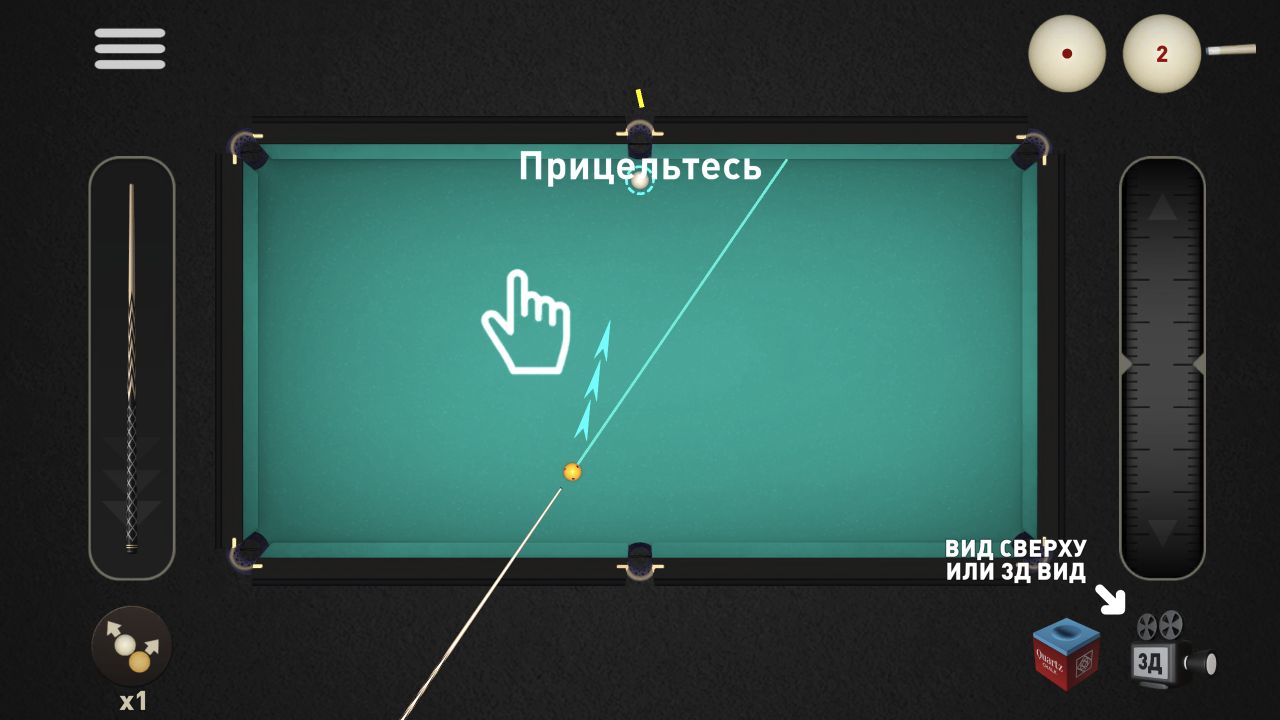
Aim advice becomes credible only when direction, power, target and outcome are separately visible. Billiards 3D opened with a cue line toward the top-middle pocket and a vertical power meter. Pool Shoot Tournament showed valued pockets and an aiming state. Bubble Blast displayed a launcher, current bubble and remaining shots.
These openings let us describe what to record. They do not let us diagnose a player’s hand control or promise that a drill will improve performance.
Record the shot as a four-part event
Our Pool Shoot click changed the aiming state while score stayed zero and bombs stayed at five. That is a valid result even without a score. The next review pass can repeat a controlled shot and add the outcome; until then, tactical advice would exceed the evidence.
- Line: where was the guide or launcher pointing before input?
- Power: did a meter or marker visibly change?
- Target: what object or pocket was selected, and what value was shown?
- Result: which score, ball, block or remaining-shot state changed afterward?
What the linked records actually contain
Billiards 3D: Russian Pyramid was tested on 2026-08-13 in Codex in-app Chromium 151.0.7922.76 at 1280×720. The recorded inputs were Click the opening table; Click once on the aiming tutorial. The visible record says: The live table opened in a Russian-language aiming tutorial. A cue line ran from the yellow cue ball toward the top-middle pocket. Top-view/3D-view controls and a vertical power meter were visible.
Pool Shoot Tournament was tested on 2026-08-13 in Codex in-app Chromium 151.0.7922.76 at 1280×720. The recorded inputs were Close the preroll; Click the table to fire toward the center. The visible record says: The active table mixed red, green, and yellow numbered balls. Pocket values read 50, 100, 250, 100, and 50 across the top. The first click changed the current aiming state while score stayed 0 and bombs stayed at 5.
Bubble Blast was tested on 2026-08-13 in Codex in-app Chromium 151.0.7922.76 at 1280×720. The recorded inputs were Close the preroll and its confirmation; Click above-left of the launcher. The visible record says: The live board began with a triangular cluster of red, blue, and orange bubbles. The launcher showed 12 remaining shots and an orange current bubble. The HUD started at score 0 with three empty star slots and locked booster buttons.
These records support only the states and inputs described above. They do not establish later-level quality, average session length, mobile behavior, popularity, learning effects or competitive balance unless a separate source or test explicitly covers that question.
References and evidence
- Billiards 3D: Russian Pyramid — hands-on evidence — Desktop (macOS), Codex in-app Chromium 151.0.7922.76, 1280×720; tested 2026-08-13.
- Pool Shoot Tournament — hands-on evidence — Desktop (macOS), Codex in-app Chromium 151.0.7922.76, 1280×720; tested 2026-08-13.
- Bubble Blast — hands-on evidence — Desktop (macOS), Codex in-app Chromium 151.0.7922.76, 1280×720; tested 2026-08-13.