Robot Unicorn Dash

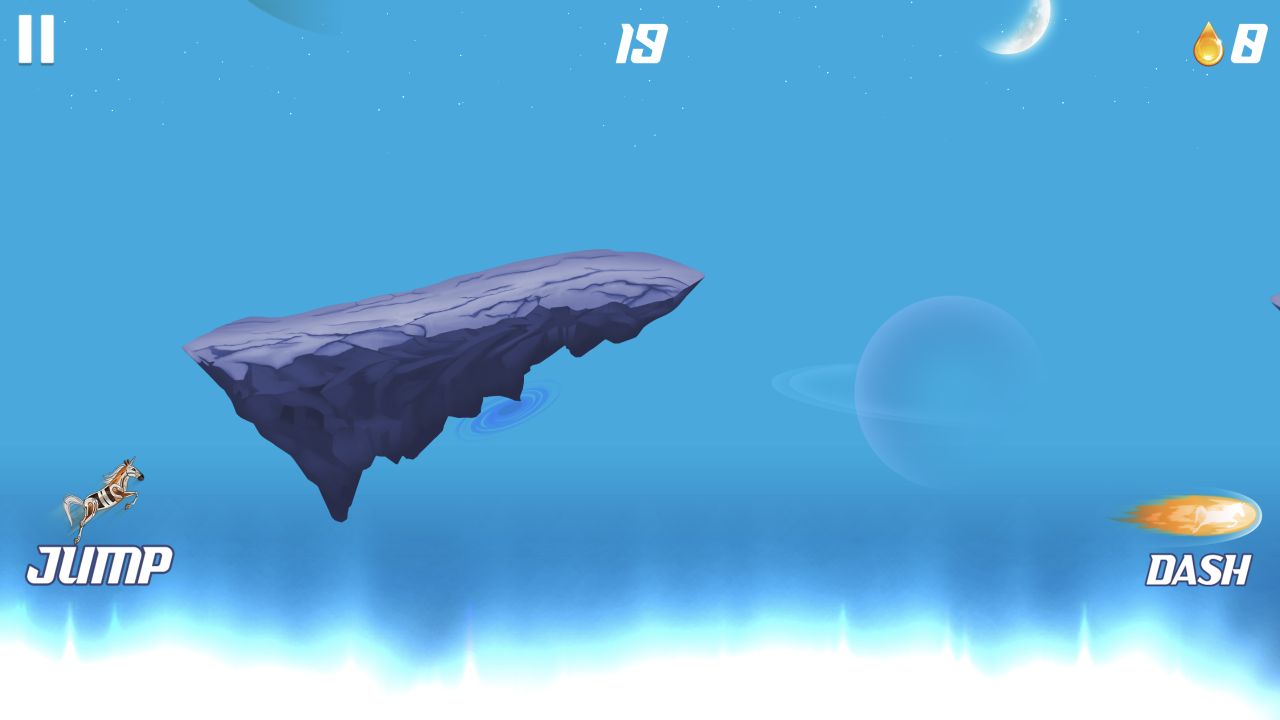
Robot Unicorn Dash is a nonstop neon runner about jumping, double jumping, collecting stars, and avoiding dark crystals.

Original editorial guideEditor score 9.2/10

Robot Unicorn Dash

Robot Unicorn Dash

Overview

Robot Unicorn Dash is an endless runner built around momentum, bright fantasy imagery, and a very small set of actions that become more demanding the longer the run survives. The character never stops moving. The player does not steer through multiple lanes, manage weapons, or solve a complicated upgrade menu. The whole game comes down to reading the next stretch of rainbow road, judging the shape of the gap, deciding whether a normal jump is enough, and saving the double jump for the moment when the first jump will not carry safely.

That narrow focus is the game's strength. Many browser runners become noisy because they keep adding buttons, currencies, enemies, and side objectives. Robot Unicorn Dash is cleaner. The fantasy setting gives it personality, but the mechanical promise is direct: keep the run alive, collect stars when the route allows it, and avoid dark crystals that break the flow. The player always understands what went wrong. A late jump, an unnecessary double jump, or a greedy star pickup can end the run. Those readable failures make the next attempt feel fair.

The contrast between the dreamy look and the pressure of the speed is important. The neon colors, sparkles, stars, and rainbow roads make the game feel light at first. But the runner pace steadily turns that softness into tension. A level does not need to become visually grim to become difficult. It only needs to ask for faster reading. Robot Unicorn Dash does exactly that: the screen remains magical, while the timing window becomes less forgiving.

As a browser game, it fits short sessions especially well. A player can understand the control loop almost immediately. One tap jumps, another tap extends the jump, and the rest is timing. That makes it friendly for mobile and desktop visitors who want instant play. At the same time, the high-score structure gives the game a reason to repeat. The next run is not about learning a new system. It is about being a little cleaner in the same system.

How it plays

Robot Unicorn Dash plays like a pure reaction-and-rhythm runner. The character moves forward automatically, and the player controls when to jump. A single tap gives the first leap. A second tap performs a double jump, extending the arc and letting the player cross wider gaps or recover from a slightly early takeoff. The simplicity makes the control scheme easy, but the timing is where the game lives.

The run is made from a chain of short questions. Is the next gap small enough for one jump? Is the landing platform long enough to save the second jump? Is the star trail safe, or is it pulling the player toward a crystal? Should the double jump happen immediately after the first jump, or should it be delayed until the character begins to drop? These questions arrive quickly, and the player answers through timing rather than menus.

The double jump is the main expressive tool. New players often use it automatically because double jumping feels safer. In reality, spending the second jump too early can create problems. If the first jump already clears the gap, the second jump may push the character too high or too far, making the next landing awkward. If a crystal appears after the gap, an early double jump may remove the one correction that would have saved the run. Better play comes from treating the second jump as insurance, not decoration.

Stars create a useful temptation. They reward route confidence, but they should not override survival. A star path that sits along the clean jump arc is worth taking. A star path that forces a risky double jump near a crystal is a trap for greedy players. This is one of the quiet ways the game creates decision-making. The player is not choosing from a menu, but every pickup line asks whether score is worth danger.

The catalog marks the game as mobile-ready for Android and iOS, and the control scheme supports that well. Tapping is natural on phones, and the game does not require precise cursor movement. The horizontal orientation is a good fit because runners need forward visibility. The player needs to see the next platform early enough to time the jump. A vertical layout would compress that information; a horizontal layout gives the run more breathing room.

Strategy notes

The first strategy is to look past the object directly in front of the character. Endless runners punish tunnel vision. If you only look at the nearest gap, you may clear it and land in the wrong place for the next obstacle. Try to read in pairs: the current jump and the landing after it. If the landing platform is short, save the double jump until you know whether you need a correction.

The second strategy is to delay the double jump when possible. A delayed second tap gives more control because it lets you adjust after seeing how the first jump develops. Tapping twice immediately can work for wide gaps, but it removes flexibility. In a runner where the screen keeps moving, flexibility is often more valuable than height.

The third strategy is to treat crystals as route anchors. A crystal is not just a hazard; it tells you where your landing should not be. When a crystal sits after a gap, the correct jump is not simply "clear the gap." The correct jump is "clear the gap and land with enough space to avoid the crystal." That distinction matters when the speed rises. Many failed runs happen because the player technically clears the first hazard but lands in a position that makes the next hazard unavoidable.

The fourth strategy is to collect stars only when the jump shape is already safe. A high-score game naturally encourages greed, and that is part of the fun. But the most reliable way to score higher is to survive longer. Passing a dangerous star cluster may feel disappointing for a second; crashing for it ends the whole run. When in doubt, choose survival. The extra distance usually pays more than one risky pickup line.

Finally, learn the rhythm of the run rather than reacting to each object as if it is separate. Robot Unicorn Dash has a musical quality even without focusing on sound. Platforms, gaps, stars, and crystals create patterns. The player who taps with that rhythm will feel less rushed than the player who waits until every obstacle is almost touching the character.

Controls

Tap once to jump. Tap a second time while airborne to double jump. Collect stars when the route is safe. Avoid dark crystals and gaps. Keep the run alive as long as possible to chase a better score.

The control scheme is one of the reasons the game works on many devices. On desktop, the player can use a mouse click or tap-style input and focus entirely on timing. On mobile, thumb taps feel immediate and easy to repeat. Because there is no steering, dragging, or multi-button sequence, input friction stays low.

That does not mean the game is effortless. The timing window narrows as the pace increases. A click that is slightly late in the first few seconds might still survive; the same delay later can hit a crystal or miss the platform. The controls are simple, but the demand curve comes from speed.

For mobile players, the best practical tip is to keep the tapping thumb low and out of the main viewing area. The game needs forward vision. If your finger covers the next platform or the star line, your reaction time becomes worse. For desktop players, keep the cursor still and use consistent clicks; unnecessary pointer movement adds nothing.

Visual feel and readability

Robot Unicorn Dash succeeds partly because its visual theme is memorable without hiding the mechanics. Neon roads, sparkles, stars, and fantasy colors create a strong identity. The game is not visually realistic, and it does not need to be. It is built for fast recognition. The player should instantly separate the safe road, the collectible star path, and the dangerous crystals.

Good runner visuals do two jobs at once. They create mood, and they communicate danger. If the art is beautiful but unclear, the game becomes frustrating. If the art is clear but bland, the run can feel disposable. Robot Unicorn Dash aims for the middle: a bright dreamlike surface with hazards that still stand out. That is why the dark crystals matter. Their darker tone cuts through the softer fantasy colors and gives the player a readable warning.

The horizontal screen shape supports this readability. In a runner, the future is always to the right. The player needs enough distance to prepare a jump before the obstacle arrives. The game being mobile-ready is useful, but the best mobile experience will still depend on screen size and performance. A small phone can make the run feel more crowded, while a larger screen gives the player more time to read upcoming gaps.

What makes it worth playing

Robot Unicorn Dash is worth playing because it understands the appeal of a compact runner. It does not bury the player under explanations. It opens with a clear fantasy, gives one satisfying movement tool, and asks for better timing each run. That kind of clarity is valuable in a browser catalog, where many games compete for attention with louder thumbnails and more complicated promises.

The game also has a clean failure loop. When the run ends, the player usually knows the exact mistake. The double jump came too soon. The star route was greedy. The landing after the crystal was too shallow. This clarity encourages one more try. A good runner should make the player feel that the next attempt can fix the last mistake, and Robot Unicorn Dash has that quality.

It is also a strong fit for players who enjoy mood as much as mechanics. The fantasy setting gives the game a distinctive flavor compared with city runners, traffic runners, and military obstacle courses. The tone is brighter and stranger, but the skill test underneath is familiar. That combination makes the game easy to recommend to casual players who want something approachable but not completely passive.

Who should play Robot Unicorn Dash

Try Robot Unicorn Dash if you like endless runners, quick restarts, bright arcade visuals, or games where a single mechanic gets sharper over time. It is especially good for players who enjoy chasing personal bests rather than completing a long checklist of missions.

It is less ideal for players who want deep progression, character builds, or many modes. The core loop is intentionally narrow. You jump, double jump, collect, avoid, and repeat. If that sounds too simple, the game may not hold you for long sessions. But if the idea of refining timing inside a fast, colorful runner sounds appealing, the simplicity becomes a strength.

Pros

The one-tap and double-jump controls are immediately understandable. The bright neon fantasy theme gives the runner a distinct identity. Dark crystals and gaps create readable hazards. Star collection adds score tension without complicating the controls. The game works naturally for short browser and mobile sessions. Failures are usually easy to understand, which makes retrying feel fair.

Tradeoffs

The core loop is narrow, so players wanting deep progression may move on quickly. Speed increases can feel harsh if you rely on late inputs. Small phone screens may reduce forward visibility. Greedy star routes can punish players who chase score before survival. Repetition may set in during long sessions because the game focuses on one main mechanic.

Tips & tricks

The first strategy is to look past the object directly in front of the character. Endless runners punish tunnel vision. If you only look at the nearest gap, you may clear it and land in the wrong place for the next obstacle. Try to read in pairs: the current jump and the landing after it. If the landing platform is short, save the double jump until you know whether you need a correction. The second strategy is to delay the double jump when possible. A delayed second tap gives more control because it lets you adjust after seeing how the first jump develops. Tapping twice immediately can work for wide gaps, but it removes flexibility. In a runner where the screen keeps moving, flexibility is often more valuable than height. The third strategy is to treat crystals as route anchors. A crystal is not just a hazard; it tells you where your landing should not be. When a crystal sits after a gap, the correct jump is not simply "clear the gap." The correct jump is "clear the gap and land with enough space to avoid the crystal." That distinction matters when the speed rises. Many failed runs happen because the player technically clears the first hazard but lands in a position that makes the next hazard unavoidable. The fourth strategy is to collect stars only when the jump shape is already safe. A high-score game naturally encourages greed, and that is part of the fun. But the most reliable way to score higher is to survive longer. Passing a dangerous star cluster may feel disappointing for a second; crashing for it ends the whole run. When in doubt, choose survival. The extra distance usually pays more than one risky pickup line. Finally, learn the rhythm of the run rather than reacting to each object as if it is separate. Robot Unicorn Dash has a musical quality even without focusing on sound. Platforms, gaps, stars, and crystals create patterns. The player who taps with that rhythm will feel less rushed than the player who waits until every obstacle is almost touching the character.

What we like, what we don't

Pros

  • The one-tap and double-jump controls are immediately understandable.
  • The bright neon fantasy theme gives the runner a distinct identity.
  • Dark crystals and gaps create readable hazards.
  • Star collection adds score tension without complicating the controls.
  • The game works naturally for short browser and mobile sessions.
  • Failures are usually easy to understand, which makes retrying feel fair.

Cons

  • The core loop is narrow, so players wanting deep progression may move on quickly.
  • Speed increases can feel harsh if you rely on late inputs.
  • Small phone screens may reduce forward visibility.
  • Greedy star routes can punish players who chase score before survival.
  • Repetition may set in during long sessions because the game focuses on one main mechanic.

Frequently asked

Does Robot Unicorn Dash stop moving?

No. The runner moves nonstop. The player controls jumps and double jumps, but the forward motion continues, so timing and early reading are the main skills.

When should I double jump?

Use the double jump when the first jump will not safely clear a gap, reach the next platform, or avoid a crystal after landing. Avoid using it automatically on every jump.

Is collecting every star important?

No. Stars help your score, but survival matters more. A dangerous star line is often not worth it if it puts the run at risk.

Is Robot Unicorn Dash good on mobile?

Yes. The tap controls fit Android and iOS play, and the horizontal layout helps show the next obstacle. Larger screens are more comfortable because they make upcoming gaps easier to read.

What is the main beginner mistake?

The most common mistake is spending the double jump too early. Save it until you know the first jump needs help or the landing needs correction.

Categories

Arcade, Adventure

Platform

Mobile

Devices

For Android, For IOS

Orientation

Landscape

Fast and Wild in Sky — play free in your browser
Balls: Ricochet! — play free in your browser
TENKYU BALL — play free in your browser
Archer Defense — play free in your browser
Stickman Archer Kick — play free in your browser
Basketball Superstars — play free in your browser
Tile Match — play free in your browser
Meme Beatdown — play free in your browser
Shape Jam — play free in your browser
Labubu Geometry Waves — play free in your browser
Snack Sort — play free in your browser
Scale the wheels — play free in your browser
Stickman Punishment 2 — play free in your browser
Pop It 3D — play free in your browser

Blog

More to read between rounds

Six random blog picks from the editorial desk.
All articles →
Gas Station Simulator gameplay preview used as editorial artwork for A Beginner's Guide to Idle and Clicker Games

Guides

A Beginner's Guide to Idle and Clicker Games

Clickers look like single-button games but they are actually a serious genre with deep design conventions. Here is how to get started.

Apr 8, 20268 min read

Catch the Bear gameplay preview used as editorial artwork for How to Play Browser Games Safely

Privacy

How to Play Browser Games Safely (Privacy & Ads Explained)

Browser games are safer than app-store games in many ways, but there are still a few habits worth keeping. Here is a plain-language explainer.

Feb 19, 20267 min read

Good Sort Master: Triple Match gameplay preview used as editorial artwork for How Tile-Matching Games Quietly Train Your Brain

Guides

How Tile-Matching Games Quietly Train Your Brain

Tile-matching works as light mental training because it teaches the brain to compress a crowded board into manageable chunks.

Mar 26, 20266 min read

Moto X3M gameplay preview used as editorial artwork for Mobile-Friendly Browser Games You Can Play on the Go

Guides

Mobile-Friendly Browser Games: What to Look For

Not every browser game runs well on a phone. Here is the editor's checklist for finding the ones that do.

Mar 11, 20266 min read

Amaze! gameplay preview used as editorial artwork for How We Review Browser Games (And What We Look For)

Behind the scenes

How We Review Browser Games (And What We Look For)

A transparent look at the simple, repeatable review process we use before a browser game earns editorial coverage on the site.

Feb 28, 20266 min read

Robby The Lava Tsunami gameplay preview used as editorial artwork for Parkour and Platforming in Browser Games

Lists

Parkour and Platforming in Browser Games

The best browser parkour and platforming games turn movement into a readable conversation between timing, route choice, and level design.

Jan 8, 20266 min read