Catch the Bear

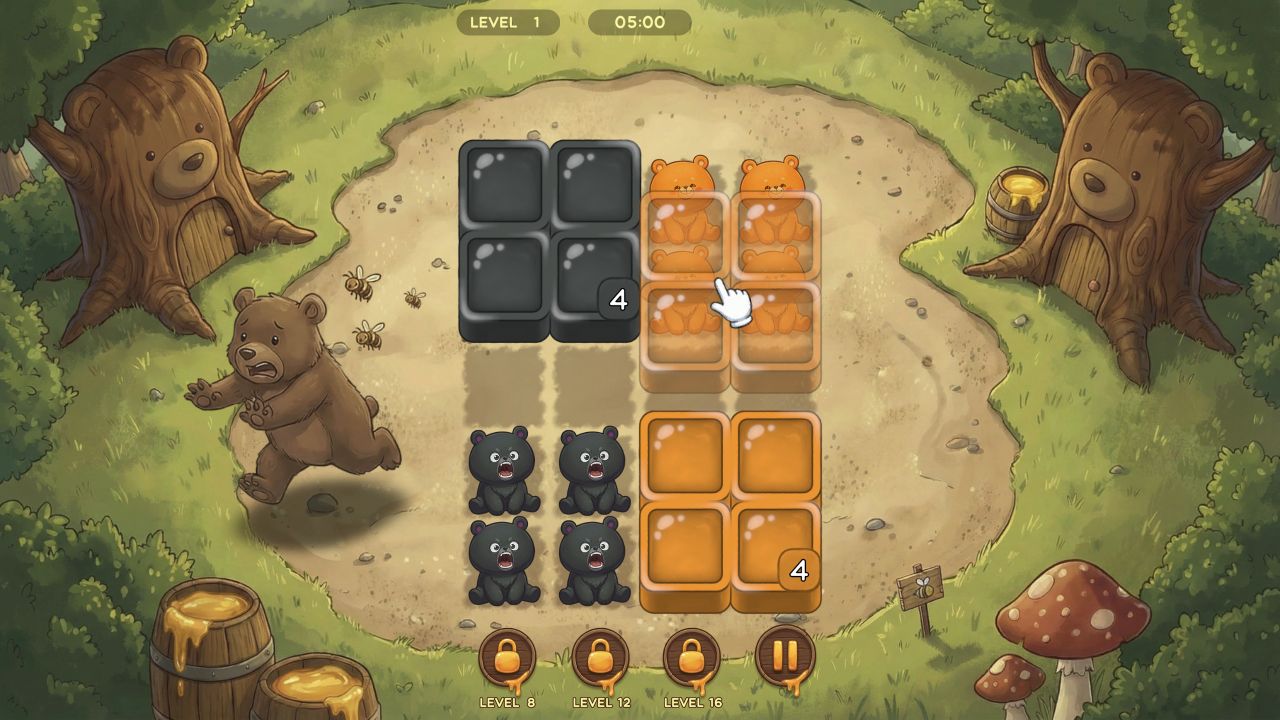
Catch the Bear is a cozy sliding-block puzzle where colored bears must be placed into matching holes.

Original editorial guideEditor score 8.5/10

Catch the Bear

Catch the Bear

Overview

Catch the Bear looks soft at first glance, but it is not just a cute color-matching toy. It is a sliding-block logic game built around route planning. The player moves blocks across a compact board, catches bears, and sends each bear into a hole that matches its color. The rules are easy to explain, which is one reason the game works well as a casual browser puzzle. The challenge comes from the spaces between those rules: which block should move first, which corridor must stay open, and which bear needs priority before the board becomes crowded.

The cozy presentation is important because it changes how the puzzle feels. A cold abstract version of the same mechanic would still work, but the bear theme makes repeated attempts less harsh. When a level fails, the board does not feel hostile; it feels like a small toy box that needs to be rearranged with more care. That tone is useful for a puzzle that gradually introduces tighter routes, blockers, and extra pressure such as time limits.

The official description emphasizes a feel-good puzzle adventure with colorful bears, smart block-sliding mechanics, and gradually increasing difficulty. That is a fair pitch. The game is accessible within seconds, but the later logic has enough dependency that players cannot simply slide the nearest piece and hope. Each move changes the remaining geometry. A block that opens one path may close another, and a bear placed too early can occupy space needed by a different color. Catch the Bear is at its best when it makes the player pause, scan the whole board, and solve the route rather than the nearest object.

For a high-quality game page, the important point is that Catch the Bear is not valuable because it has cute characters alone. The value is in the combination of friendly visuals and real planning. The article should help players understand how to approach the board, where mistakes usually happen, and whether the game fits their preferred puzzle style. That is the difference between a thin catalog note and a useful editorial review.

How it plays

The core action is sliding. You move blocks across the board to create paths, catch bears, and guide them toward matching colored holes. A level is complete when every bear reaches the correct destination. The first boards teach the relationship between color and goal. Later boards become more interesting because the paths overlap. One bear may need to cross a lane that another bear is already using. A blocker may force you to take a longer route. A hole may be easy to reach, but using it too soon may remove the only useful turning space.

The best way to read a level is to treat the holes as anchors. Before moving anything, identify where each bear must end up. Then look for the most restricted route. A bear with only one path should usually be solved before a bear with several choices. If you clear the flexible bear first, you might accidentally park pieces in the only lane the restricted bear needs. This is a common sliding-puzzle mistake, and Catch the Bear makes it visible because the colored holes give the board clear goals.

Movement also has a rhythm. A good move is rarely just "slide this block because it can move." A good move changes the board while preserving future options. You might slide a block to open a corridor, then move a bear halfway, then move the block back into a safer position. This kind of temporary rearrangement is where the puzzle becomes satisfying. The player is not just dragging pieces toward targets; the player is staging a sequence.

If a level includes a time limit, it is better to use the first attempt as a map-reading pass. Learn which color gets trapped, which block is blocking the center, and where the final move needs to happen. Once the route is understood, the timer becomes a clean execution challenge rather than a source of panic. That balance between relaxed discovery and sharper replay is one of the stronger parts of the game.

What the first few levels teach

The opening levels are valuable because they teach the player to respect empty space. Empty cells are not wasted space in a sliding puzzle. They are the engine that lets everything else move. When you fill every open lane with a bear or a block, the board loses flexibility. Catch the Bear gradually trains this idea by letting early moves feel easy, then adding arrangements where a single crowded corridor can trap the wrong color.

The second lesson is exact color matching. The board may look playful, but the goal is precise. Sending the wrong bear toward a convenient hole does not solve the level. More importantly, it may block a correct route. Players should slow down long enough to check both the bear and the destination before committing a move. On a phone, this matters even more because the screen is vertical and the pieces may be close together.

The third lesson is that blockers are not always obstacles to remove immediately. Sometimes a blocker is a wall that helps shape the route. If moving it opens too much space, a bear may slide into an awkward position or a corridor may lose its clean direction. The game becomes richer when you stop seeing every blocker as bad and start asking what position each block is currently protecting.

Practical strategy

Work backward from the holes. This is the simplest and most reliable strategy. Ask which bear can reach its hole with the fewest route choices. Solve that route first or at least prepare it before spending moves elsewhere. If two bears share a corridor, decide which color must pass through first. Do not let a flexible bear sit in the middle while the restricted bear is still waiting.

Keep one maneuvering space open near the center whenever possible. A corner opening can help, but center space is usually more powerful because several routes can connect to it. If the board has one obvious hub, protect it until you know the final sequence. Many failed attempts happen because the player clears a tempting match while accidentally filling the hub.

Use retries as information rather than frustration. When a level fails, ask what moved too early. Did you send a bear to its hole before clearing another route? Did a block slide into a place where it could not be moved back? Did the timer make you choose a partial route instead of the full sequence? These questions turn a restart into a better second attempt.

For players chasing cleaner solves, count dependency chains. A dependency chain is a line of "this must happen before that." For example, the blue bear may need the red block moved, but the red block cannot move until the yellow bear leaves the lower lane. Once you identify the chain, the level becomes much less random. Catch the Bear often rewards that type of thinking without making the interface complicated.

Device feel and controls

Slide blocks: Move pieces across the board. Color matching: Place bears into correct holes. Route planning: Use open space carefully.

The game is listed for Android, iOS, and desktop, with a vertical orientation. That is the right shape for this kind of puzzle because the entire board can stay visible while the player uses touch controls. On mobile, the sliding action feels natural, but accuracy matters when multiple pieces sit close together. On desktop, mouse input makes it easier to select one block at a time and to think through a route without covering part of the board with your finger.

The controls are simple enough for children and casual players, but the planning layer gives older puzzle fans something to chew on. That broad reach is one reason the game can work on an AdSense review site: it has a clear audience, a clear mechanic, and enough specific gameplay detail to support a real article rather than a generic listing.

Editorial assessment

Catch the Bear should be evaluated on clarity, fairness, level variety, and replay comfort. Clarity means the player can tell which bear belongs to which hole and what each slide will likely do. Fairness means failures come from planning mistakes, not from hidden rules. Level variety means later stages introduce new routes, blockers, and time-pressure situations instead of simply shrinking the board. Replay comfort means a failed level remains inviting enough to try again.

The game appears strongest in clarity and tone. The colors give immediate objectives, and the cozy bear presentation softens the difficulty. Its biggest risk is the usual sliding-puzzle risk: if a board becomes too tight without enough visual feedback, players may feel they are guessing. The best way to enjoy the game is to play slowly enough to notice why the route failed. Once you can explain the mistake, the next attempt becomes satisfying.

This is a good recommendation for players who like block puzzles, color matching, and gentle logic games. It is less ideal for players who want fast action or heavy story progression. The game has personality, but its main content is the puzzle board. That should be treated as a strength rather than disguised. A focused, board-first puzzle is exactly what many casual players want during a short break.

Pros

Calm presentation with real logic challenge. Color matching makes goals clear. New obstacles support progression. Vertical play suits phones and tablets well. Failed levels usually teach a route lesson for the next attempt.

Tradeoffs

Tight spaces can require several retries. Sliding one block may block another route. Similar colors or crowded layouts can slow play on small screens. Players looking for speed or combat may find the pace too thoughtful.

What we like, what we don't

Pros

  • Calm presentation with real logic challenge.
  • Color matching makes goals clear.
  • New obstacles support progression.
  • Vertical play suits phones and tablets well.
  • Failed levels usually teach a route lesson for the next attempt.

Cons

  • Tight spaces can require several retries.
  • Sliding one block may block another route.
  • Similar colors or crowded layouts can slow play on small screens.
  • Players looking for speed or combat may find the pace too thoughtful.

Frequently asked

What is the goal of Catch the Bear?

Place all bears into their matching colored holes.

What makes levels harder?

New obstacles, tighter spaces, and more dependent movement routes increase the challenge.

Is Catch the Bear relaxing or difficult?

It starts relaxing because the rules and visuals are gentle. The difficulty grows through route planning, blockers, and optional time pressure, so later levels can become genuinely strategic.

What is the best beginner habit?

Look at the holes first, then solve the bear with the most restricted path. Keeping open space near the center is usually more useful than rushing the nearest color match.

Does it work better on mobile or desktop?

Both are suitable. Mobile touch controls feel natural for sliding pieces, while desktop mouse input can be more precise when a board becomes crowded.

Who should play it?

Catch the Bear is best for players who enjoy cute logic puzzles, block sliding, color matching, and short levels that can be retried without a heavy time commitment.

Categories

Puzzle, Strategy

Platform

Desktop + mobile

Devices

For Android, For IOS, For Desktop

Orientation

Portrait

JuicyJong — play free in your browser
Balls: Ricochet! — play free in your browser
Amaze! — play free in your browser
Wood Nuts Master: Screw Puzzle — play free in your browser
Hook Pin Jam — play free in your browser
Stickman Archer Kick — play free in your browser
Pool Shoot Tournament — play free in your browser
Wood Blocks Jam — play free in your browser
Tile Match — play free in your browser
Help Tricky Story A Complicated Story — play free in your browser
Balls Animal — play free in your browser
Mindblow — play free in your browser
Coloring by Numbers. Pixel Room — play free in your browser
Bridge Builder — play free in your browser

Blog

More to read between rounds

Six random blog picks from the editorial desk.
All articles →
Ragdoll Crash-Test: Throw and Break! gameplay preview used as editorial artwork for Why Controls Matter More Than Graphics

Opinion

Why Controls Matter More Than Graphics

Pretty art can attract attention, but poor controls are what make players close the tab for good.

Mar 10, 20266 min read

Good Sort Master: Triple Match gameplay preview used as editorial artwork for How Tile-Matching Games Quietly Train Your Brain

Guides

How Tile-Matching Games Quietly Train Your Brain

Tile-matching works as light mental training because it teaches the brain to compress a crowded board into manageable chunks.

Mar 26, 20266 min read

Snake 2048 gameplay preview used as editorial artwork for How to Pick the Right .IO Game for Your Mood

Guides

How to Pick the Right .IO Game for Your Mood

The .IO genre has split into half a dozen subgenres. Here is how to pick the right one for the next twenty minutes.

Apr 15, 20267 min read

2048 3D: Merge Cubes gameplay preview used as editorial artwork for The Best Merge Games for Relaxing Play

Lists

The Best Merge Games for Relaxing Play

The most soothing merge games turn clutter into order at a pace that feels deliberate rather than sleepy.

Apr 8, 20266 min read

Gas Station Simulator gameplay preview used as editorial artwork for A Beginner's Guide to Idle and Clicker Games

Guides

A Beginner's Guide to Idle and Clicker Games

Clickers look like single-button games but they are actually a serious genre with deep design conventions. Here is how to get started.

Apr 8, 20268 min read

Stickman Archer Kick gameplay preview used as editorial artwork for Action Games for Short Breaks: Curated Picks

Lists

Action Games for Short Breaks: Curated Picks

An editor-led list of action games designed for the kind of break where you have ten minutes and want to feel something.

Feb 26, 20266 min read